How Digital Marketing for Accountants Turns Online Visibility into a Steady Client Pipeline?
Referrals are brilliant, until they are not. Most accounting firms are built on them. Then, quietly,...
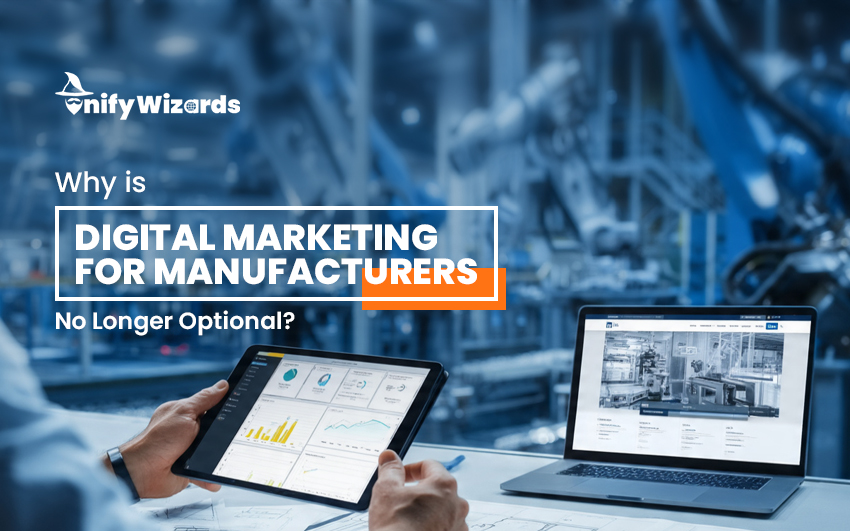
Digital marketing for manufacturers has moved from a nice-to-have to a business-critical function. Over 87% of manufacturing buyers now complete their research online before ever speaking to a sales representative. If your business isn't visible during that research phase, you're already out of the running.
Trade shows, printed catalogues, and cold calls still have a place. But they can't carry a manufacturing business in 2026's competitive landscape. Buyers; engineers, procurement managers, plant directors, etc. all are researching suppliers on Google months before raising an RFQ. Your digital presence is your first pitch, whether you're ready for it or not.
A digital marketing agency is now needed. Manufacturing organisations have taken notice. Digital marketing budgets across the sector rose from 6.7% of revenue in 2024 to 9.5% in 2025, according to Gartner. The ones increasing spend aren't doing it out of trend-chasing. They're doing it because it works.
Digital marketing for manufacturers is the process of using online channels to reach buyers, generate leads, and grow your business. It includes SEO, paid ads, content, email, and social media, all working together to bring the right people to your website.
It is not complicated in principle. Buyers search for suppliers online. Your job is to show up when they do. The manufacturers that invest in their digital presence consistently win more enquiries than those that don't. That's really what it comes down to.
Digital marketing for manufacturers works by combining several online channels into one consistent strategy. Each channel serves a different purpose, and together they cover the full buyer journey, from first search to first contact.
Here is a simple breakdown of what each channel does:
Digital marketing for manufacturing doesn't follow the same rules as consumer or SaaS marketing. The buyers are different, the sales cycles are longer, and the content that converts is far more technical and specific.
A consumer purchase takes minutes. A B2B manufacturing contract can take 6 to 18 months from first search to signed order. Multiple stakeholders are involved, engineers evaluating specs, procurement comparing costs, finance assessing risk. Your digital marketing has to speak to all of them, at different stages, with different messages.
Generic marketing tactics fall flat here. A clever tagline won't move a procurement manager. A downloadable spec sheet, a detailed case study, or a precise technical comparison definitely will. The content that works in manufacturing is built on proof... certifications, tolerances, real outcomes. That's a fundamentally different discipline.
| Feature | Before Digital Marketing | After Digital Marketing |
| How buyers find you | Referrals and trade shows | Google searches and LinkedIn |
| Lead consistency | Unpredictable | Steady and measurable |
| Working hours | Office hours only | 24/7 online visibility |
| Cost per lead | High and untracked | Tracked and optimised |
For most manufacturing companies, SEO and content marketing deliver the highest return over the long term. Paid search delivers results faster. LinkedIn works well for building brand awareness with specific decision-makers.
The right mix depends on your goals. If you need leads quickly, start with paid ads. If you want a steady flow of inbound enquiries over time, invest in SEO and content. Most manufacturers benefit from running both alongside each other.
Email is consistently underused in manufacturing. A simple monthly newsletter or follow-up sequence can keep warm leads engaged across a sales cycle that might last six to twelve months. That consistency pays off.
Getting started does not have to be overwhelming. These steps cover the basics in the right order.
Your website is the first thing a buyer judges you on. It needs to load quickly, work on mobile, and clearly explain what you make and who you serve. If it looks outdated, buyers will assume your business is too.
This is free and takes under an hour. It helps your business appear in local search results and Google Maps. Add your address, phone number, services, and photos. Ask happy clients to leave a review.
Think about what your ideal buyer types into Google. Be specific "stainless steel fabrication UK" is better than "metal." These are the terms your website and content need to be built around.
It does not need to be long. A short guide, a case study, or a product FAQ page all count. Each one gives Google another reason to show your website; and gives buyers another reason to trust you.
Post once or twice a week. Share what you make, who you work with, and what problems you solve. It takes twenty minutes a week and builds visibility with exactly the kind of people who buy from manufacturers.
Know where your leads are coming from. If you don't track it, you can't improve it. Even a simple spreadsheet noting whether enquiries came from Google, a referral, or LinkedIn gives you useful data to work with.
SEO services typically takes three to six months to show meaningful results. That timeline puts many manufacturers off, but the leads generated after that point keep coming without ongoing ad spend.
We know it by now that it works faster. A Google Ads campaign can start generating enquiries within a week of going live. The trade-off is that results stop the moment you stop spending. Most manufacturers use both, paid for short-term results, SEO for long-term growth.
It builds slowly but steadily. Consistent posting over three to six months builds the kind of brand recognition that means buyers think of you first when a requirement comes up.
Digital marketing for manufacturing costs vary depending on what you do in-house and what you outsource. A basic setup: Google Business Profile, a refreshed website, and simple content, can be done for very little. A full strategy including SEO, paid ads, and content typically runs from £1,500 to £5,000 per month with an agency.
The more useful question is not what it costs, but what it returns. A single new manufacturing contract is often worth tens of thousands of pounds. Even one additional client per quarter, generated through digital marketing, typically more than covers the investment.
Start with what you can manage. Improve your website. Claim your Google Business Profile. Publish one case study. These are free or near-free steps that lay the foundation for everything else.
Yes; particularly for manufacturers looking to reduce their reliance on trade shows, referrals, or a small number of key accounts. Digital marketing creates a consistent, measurable source of new enquiries that isn't dependent on who you happen to meet at an exhibition.
The manufacturers getting the best results are not spending the most money. They are being consistent. Regular content, an optimised website, and a simple paid campaign maintained over twelve months will outperform a large one-off investment every time.
The goal is not to replace your existing sales approach. It is to make sure that when a buyer is searching for exactly what you offer, your business is the one they find.
Now that you know that digital marketing for manufacturers is very important, you don’t have to handle it all alone; try booking a free audit with Unify Wizards and then take your marketing game to the next level.
Reach out now!
Referrals are brilliant, until they are not. Most accounting firms are built on them. Then, quietly,...
A digital marketing agency for startups helps early-stage businesses get found online, attract the r...
Running a small business means wearing many hats. Marketing often ends up at the bottom of the list...
The healthcare industry is more competitive than ever. Patients no longer rely solely on word-of-mou...